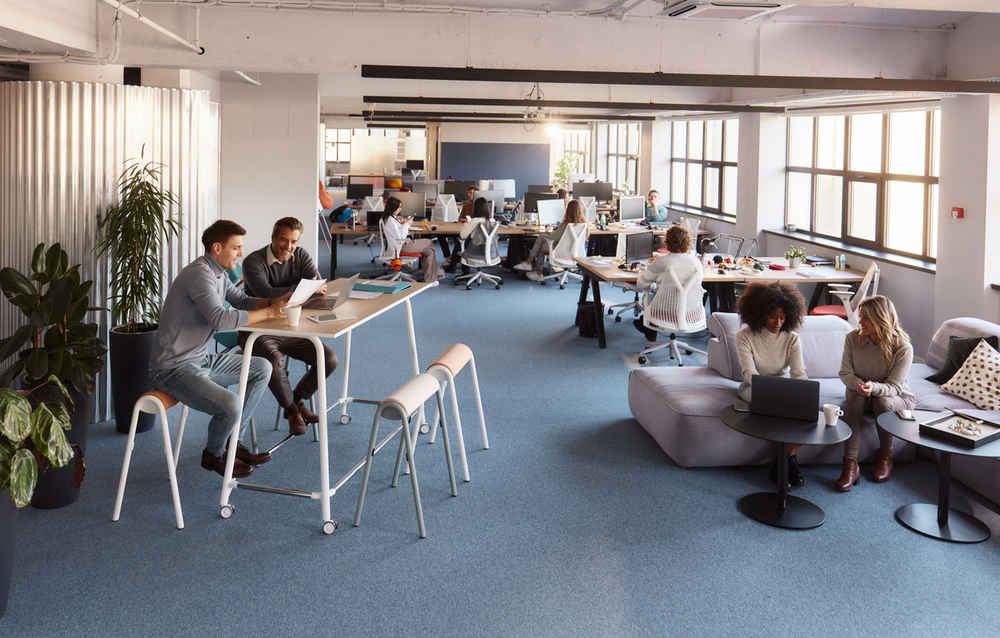
The open workspace debate has been running in the agency business for decades. It has never been more complicated than it is now, with hybrid and remote work reshaping how agencies think about physical space, when people are actually in the office, and what the office is actually for.
The core tension has not changed. Collaboration requires proximity and spontaneity. Deep creative work requires quiet and solitude. The challenge is designing a workspace that serves both without sacrificing either.
The Chiat/Day Experiment
The original grand experiment in agency open workspace was at Chiat/Day in Los Angeles in the 1990s. Jay Chiat eliminated private offices entirely. Employees received laptops and phones as needed and worked wherever they could find space. Equipment was shared. Project rooms had to be booked.
It fell apart quickly. Technology needs changed daily and there was never enough equipment to go around. Employees came in early to claim and hide gear. Senior staff pulled rank on junior staff. Some resorted to storing their working materials in the trunks of their cars. Morale collapsed.
When Chiat/Day relocated, they replaced the open workspace experiment with what they called Advertising City: a neighborhood of offices, designated collaborative spaces, and informal gathering areas designed to encourage people to stay, connect, and work whenever they wanted. The lesson was not that open workspace was wrong. It was that people need both kinds of space, and the balance matters.
Today the conversation has shifted again. Wireless technology and cloud-based tools mean that work can happen anywhere. For many agencies, the office is no longer where work gets done. It is where collaboration, culture, and connection happen. That changes what the physical space needs to do.
Does Open Workspace Work in Smaller Agencies?
There are valid reasons for an agency to embrace open workspace design. The decision comes down to knowing your culture, your people, and what your space actually needs to support.
Open workspace may be right for your agency if you:
- Need to reduce square footage for economic reasons
- Have a team-oriented culture you want clients to see when they visit
- Want to signal transparency, collaboration, and flexibility
- Are trying to attract talent who have no interest in being isolated in a private office
- Work with part-timers, freelancers, and contractors who need occasional space to plug in
- Want leadership to remain visible and accessible to staff
- Are designing for a hybrid team where in-office days are primarily about collaboration rather than heads-down individual work
Open workspace also has real drawbacks worth understanding before committing to the design:
- Phone calls and sensitive client or vendor conversations have nowhere to go
- Noise and lack of speech privacy are consistently the top complaints from open workspace employees
- Creatives in particular need extended periods of uninterrupted quiet to do their best thinking
- Many employees work better with a defined personal space, somewhere that feels like their own
What Works and What Does Not
Most people spend the majority of their working time on quiet, focused individual work rather than active collaboration. A workspace designed only for collaboration will underserve the work that actually gets done most of the time.
The most effective agency workspaces blend open and private spaces deliberately. For collaborative work, consider tables, booths, interlocking desk configurations, small and large meeting rooms, and kitchen or lounge areas that double as informal meeting spaces. Sound masking systems can reduce voice carry across open areas and help people concentrate without full physical separation.
For focused individual work, alcoves, small enclosed spaces, and high-partition desk areas give creatives and account staff the quiet they need for individual thinking, client calls, and detailed work. If dedicated quiet spaces are not feasible, establish clear norms: headphones signal unavailability, and certain times of day are protected from interruption.
For hybrid teams, the calculation shifts further. If employees are in the office primarily for collaborative work and handle focused individual work remotely, the space can lean more heavily toward open collaboration design. If people are in the office full time, the balance of open and private space needs to reflect the full range of work that happens there.
Consider which roles genuinely require private offices regardless of the overall design philosophy. Human resources handles sensitive conversations that cannot happen in the open. Finance and accounting need privacy for billing, collections, and financial review. Senior leadership manages confidential business that should not be conducted within earshot of the full staff. Glass-walled offices with blinds allow these functions to operate privately while maintaining a sense of openness and accessibility the rest of the time.
The right answer is different for every agency. By blending private and open spaces around how your people actually work, and by being honest about when and why they come into the office, you can design a workspace that supports both creativity and productivity without asking anyone to sacrifice one for the other.


