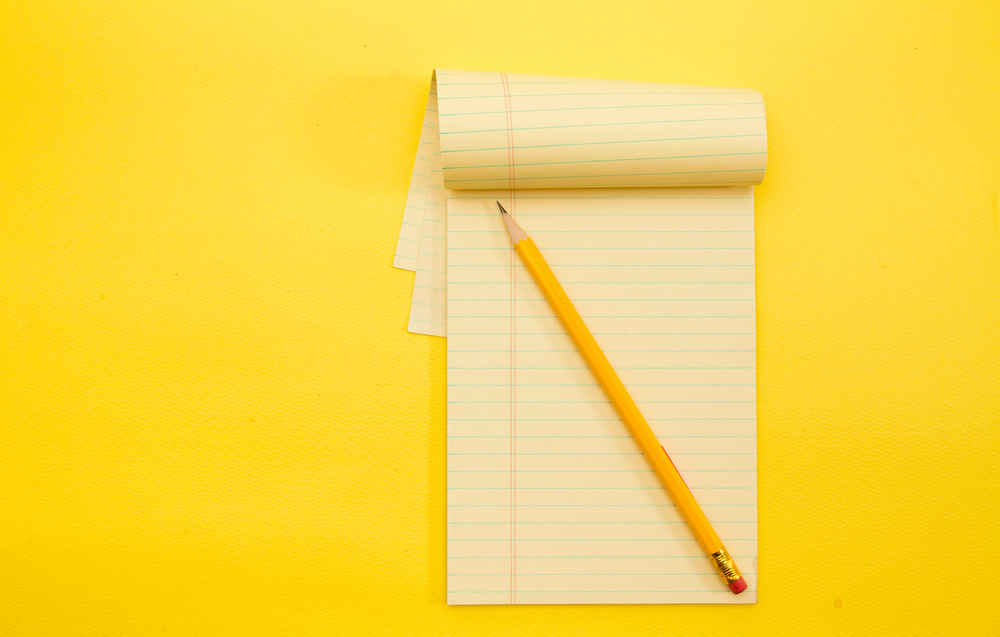
There may be no less sophisticated piece of equipment in an agency than a yellow legal pad. It cannot search the internet, resize an ad, build a presentation or generate 50 headline options in a matter of seconds. It doesn't sync with anything, and it doesn't save automatically. You have to pick up a pen and do the work yourself. That may be exactly why it is worth reconsidering.
For years, technology has steadily removed friction from the way we work. Faster computers, better software, cloud-based collaboration and instant access to information have made agencies considerably more efficient. More recently, AI has added another layer of speed by giving us useful starting points for research, writing, ideation and production.
At the same time, there has been a noticeable pull in the opposite direction. Vinyl records, film cameras, paper journals, printed books and other tactile pursuits have found new audiences, including people who grew up in a digital world. The Global Wellness Summit identified "analog wellness" as one of its major trends for 2025, pointing to a growing appetite for slower, low-tech experiences as more of everyday life takes place on screens.
This isn't necessarily a rejection of technology. It may simply be a recognition that doing something with your hands creates a different experience from doing it on a screen. For agencies, that matters because thinking and making have become so closely intertwined that we may be losing some of the space that once existed between the two.
Richard Nixon's Yellow Pads
Richard Nixon offers an interesting example of the legal pad as a thinking tool. In his memoir, Nixon wrote that he had accumulated more than 20,000 pages of handwritten notes during his public career, most of them on yellow legal pads. They stretched from his 1946 congressional campaign to the outline for his 1974 resignation speech.
The habit carried into the White House. Before his 1972 trip to China, Nixon used one of those pads to reduce a complicated diplomatic challenge to three headings: "What they want," "What we want" and "What we both want." Under them, he worked through the priorities of China, the United States and the interests the two countries shared.
The lesson isn't that Nixon had discovered some special quality in yellow paper. It is that he had a habit of forcing complicated subjects onto a page where they had to be organized and reduced to their essentials. He had to decide what mattered. Agencies could use a little more of that.
The Value of a Little Friction
A legal pad gives you very little assistance, which is part of its usefulness. There is no template determining how the thought should be structured, no image search pulling you toward an execution and no presentation software encouraging you to start packaging the idea before you have fully worked through it. You begin with what you know, what you don't know and whatever connections you can make between them.
There is research suggesting that physical writing engages us differently. A University of Tokyo study found that people who recorded information on paper completed the task faster than participants using tablets or smartphones and later showed greater brain activity in areas associated with memory, language and visualization. That does not prove that writing on a legal pad makes anyone more creative. But it does support something many people recognize intuitively: working on paper is a different experience from working on a screen.
The practical difference may be even more important. Writing by hand slows the process just enough to make you spend time with a thought. You cross something out, circle something worth keeping or draw an arrow between two ideas. The page becomes a record of how the idea developed rather than simply a place to put the final answer. That kind of friction can be productive, particularly in a business increasingly designed to eliminate it.
When Thinking and Making Became the Same Step
Agency work once had more separation between thinking and execution. Copywriters filled notebooks with headlines. Art directors worked through thumbnail sketches. Creative teams pinned rough concepts to walls. Strategists covered pads and whiteboards with observations, questions and connections. The work looked unfinished because it was unfinished.
Modern tools have compressed that process considerably. A rough idea can become a polished layout quickly. A strategic thought can become a presentation before it has been fully tested. Search tools, templates and AI can all provide useful starting points almost immediately.
Those capabilities are enormously useful, but they can also change the sequence of the work. Once an idea has a compelling image, good typography, a well-designed deck or polished language around it, it begins to feel more resolved. The presentation can start making a case for the idea before the idea has fully made a case for itself.
We are also surrounded by tools that suggest where to go next. If we rely on them too early, we risk spending more time reacting to possibilities than developing our own point of view about what the problem actually requires. The tools were not necessarily better in the past. The sequence may have been.
Protect the Thinking Stage
There are very good reasons for agencies to use every technology that makes the work better. Research tools can help us understand a subject faster. AI can help explore alternatives and generate variations. Production software allows us to execute ideas with a level of speed and sophistication previous generations could not have imagined. The argument for the legal pad is not an argument against any of those things. It is an argument for preserving a stage before them.
Before searching for inspiration, opening the presentation template or asking for a list of possibilities, spend some time with the problem on paper. What does the client actually need to accomplish? What does the audience want or care about? Where do those interests meet? What do we know that matters, and what are we assuming?
Nixon's "What they want. What we want. What we both want." is a useful model because it shows how much clarity can come from reduction. Agency problems may not be geopolitical negotiations, but they often arrive surrounded by research, client opinions, competitive information, analytics, brand standards and a long list of requested deliverables. Before deciding what to make, someone still has to determine what all of that information means. A legal pad provides a surprisingly good place to do it.
Put Some Craft Back Into the Process
Agency work has always been a combination of ideas, strategy and craft. Technology has changed the craft dramatically and mostly for the better. But as execution becomes easier, the thinking behind it becomes more important. If more people can produce polished work quickly, polish alone becomes less differentiating.
That work does not require abandoning digital tools. It may simply require knowing when not to reach for them. Maybe the first step in a creative process shouldn't always be opening a laptop. Put the brief on the table, take out a legal pad and spend some time working through the problem before searching or producing anything.
The legal pad won't make anyone more creative. What it can do is create a little space between receiving a problem and rushing toward an answer. In an industry with more ways than ever to make things quickly, that space may be worth protecting.


